Quick answer: AP Chemistry lessons is a PDF book of 70 pages with 16 lesson chapters, for AP Chemistry. It costs $9.99, paid once by PayPal, downloads instantly on up to 3 devices and prints well in black and white. Written by a team of 12 qualified science teachers.
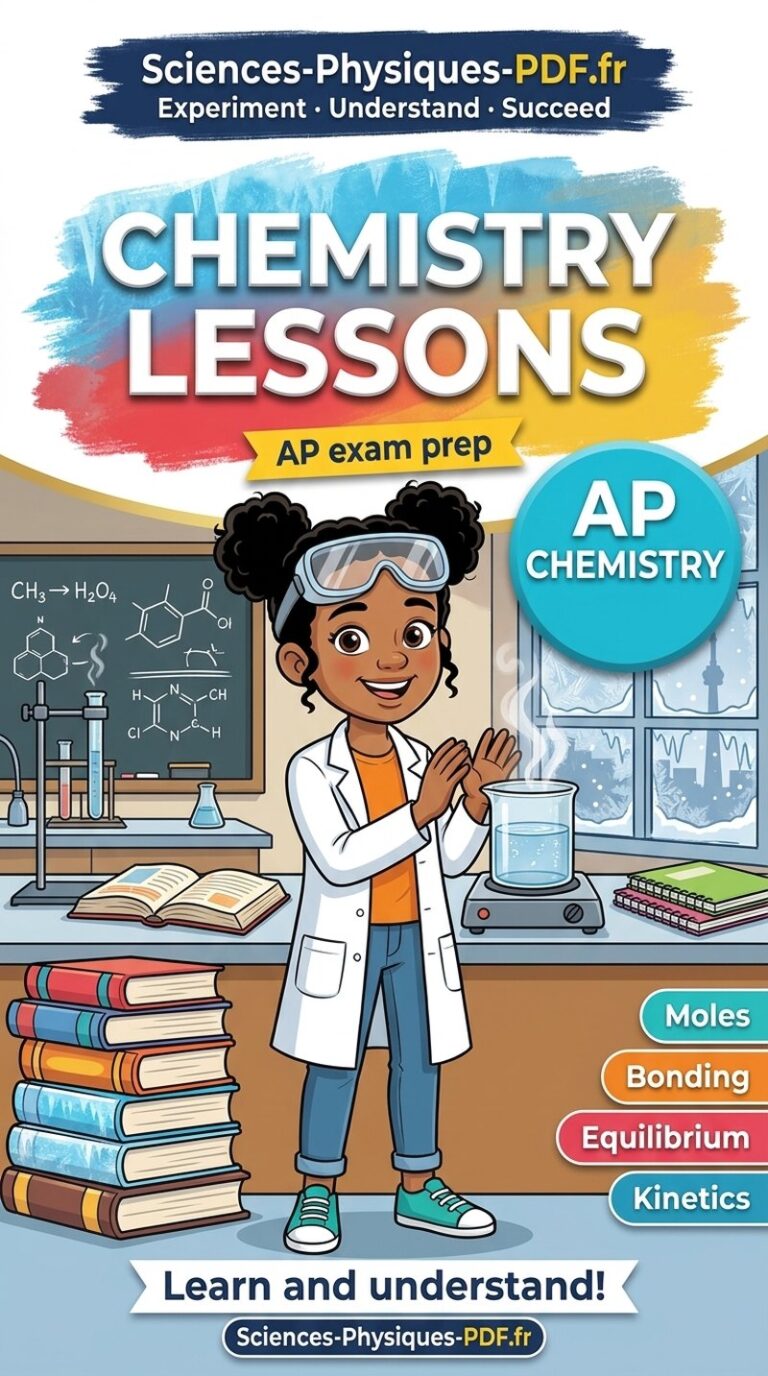
AP Chemistry
The nine units of AP Chemistry in 16 chapters, for US high school students preparing for the AP exam and for first-year university chemistry.
$9.99 one-time payment
- 70 pages in one PDF book
- 16 lesson chapters
- Quick answer, worked examples and diagrams in every chapter
- Key points and a tip from Lina
- Secure PayPal payment, no subscription
- Instant download, on up to 3 devices
- Prints well in black and white
Inside the AP Chemistry lessons
The book begins with “moles, isotopes and chemical formulas” and ends with “cells, cell potential and electrolysis”, so it follows the course from atomic structure to bonding, reactions, kinetics, thermodynamics, equilibrium, acids and electrochemistry. The chapter on “buffers, titration curves and indicators” shows how to read a titration curve, “Ksp, precipitation and the common ion effect” explains the common ion effect with worked calculations, and “entropy, Gibbs energy and spontaneity” links entropy and Gibbs energy to spontaneity. Every chapter opens with a quick answer, states the key law and formula with units, and works through at least two examples with balanced equations. Each chapter has three or more diagrams and closes with key points, a common mistake, a tip from Lina and five questions and answers.
Table of contents
- Moles, isotopes and chemical formulas
- Electron configurations, PES and periodic trends
- Lewis structures, shapes and hybridization of molecules
- Forces between particles and what they decide
- Gas laws and particle motion
- Concentration, separation and absorbance
- Net ionic equations, titration and redox
- Rate laws, orders and half-lives
- Mechanisms, catalysts and activation energy
- Heat, enthalpy and Hess's law
- Equilibrium constants and shifts
- Strong and weak acids, bases and pH
- Buffers, titration curves and indicators
- Ksp, precipitation and the common ion effect
- Entropy, Gibbs energy and spontaneity
- Cells, cell potential and electrolysis
Want to try a chapter first? Every AP Chemistry chapter is free to read on the website: open the free AP Chemistry pages.
Frequently asked questions
Who are the AP Chemistry lessons for?
They suit US high school students preparing for the AP Chemistry exam, and first-year university students revising general chemistry.
How is a chapter organised?
Each of the 16 chapters opens with a quick answer, explains the idea step by step with worked examples and diagrams, and ends with key points to remember, a common mistake to avoid, a tip from Lina and five frequently asked questions. Read from “moles, isotopes and chemical formulas” to “cells, cell potential and electrolysis”, or jump straight to “mechanisms, catalysts and activation energy” if that is the topic you need.
What comes after the AP Chemistry lessons?
The next step is a first-year university chemistry course, where the same units are met again in more depth.
How do I get the AP Chemistry lessons?
Pay once with PayPal and the PDF is ready to download at once. It opens on up to 3 devices, so it can live on a laptop and a tablet.
The other AP Chemistry books