Quick answer: Chemistry grades 11-12 lessons is a PDF book of 102 pages with 22 lesson chapters, for chemistry grades 11-12 (A Level · IB · Class 11-12). It costs $9.99, paid once by PayPal, downloads instantly on up to 3 devices and prints well in black and white. Written by a team of 12 qualified science teachers.
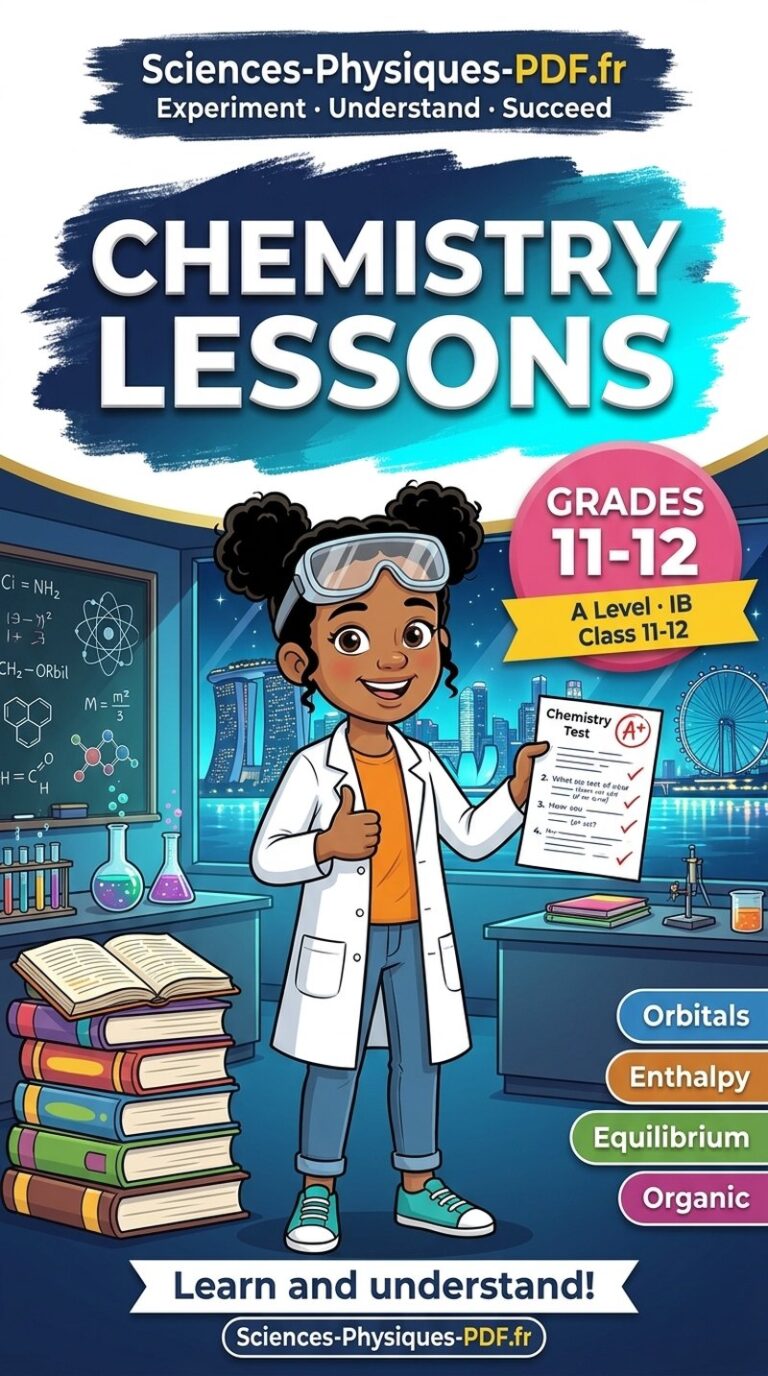
Chemistry grades 11-12
Advanced chemistry for ages 16 to 18, for A Level, IB Chemistry, CBSE Class 11-12 and WAEC or NECO senior students.
$9.99 one-time payment
- 102 pages in one PDF book
- 22 lesson chapters
- Quick answer, worked examples and diagrams in every chapter
- Key points and a tip from Lina
- Secure PayPal payment, no subscription
- Instant download, on up to 3 devices
- Prints well in black and white
Inside the chemistry grades 11-12 lessons
The book begins with “orbitals, configurations and ionisation energy patterns” and ends with “solving structures with mass, IR and NMR spectra”, taking physical, inorganic and organic chemistry in a single sequence. The physical chemistry chapters, from “heat changes, energy cycles and bond enthalpies” to “entropy, Gibbs energy and reaction feasibility”, cover energetics, rates, equilibrium, acids, redox and feasibility, and the organic chapters, from “naming organic compounds and their isomers” onwards, build up from naming and isomers to synthesis. Every one of the 22 chapters opens with a quick answer, states the key law, shows the formula with its units, and uses worked examples to show how to set out a full answer. Three or more diagrams, key points, a common mistake, a tip from Lina and five questions and answers finish each chapter.
Table of contents
- Orbitals, configurations and ionisation energy patterns
- Moles, formulae, gas volumes and atom economy
- Predicting molecular shape, bond angles and polarity
- London, dipole and hydrogen bond attractions between molecules
- Period 3 trends in radius, energy and melting
- Heat changes, energy cycles and bond enthalpies
- Orders, rate constants and activation energy
- Equilibrium constants and shifting equilibria
- Strong and weak acids, pH and buffer solutions
- Oxidation numbers and balancing redox equations
- Galvanic cells, electrode potentials and electrolysis
- Entropy, Gibbs energy and reaction feasibility
- Reactivity trends in group 2 and the halogens
- Colour, complexes and catalysis in the d-block
- Naming organic compounds and their isomers
- Radical and nucleophilic substitution reactions
- Alkenes: double bonds and addition reactions
- Oxidising alcohols and testing carbonyl compounds
- Making and reacting esters and acyl chlorides
- Benzene structure and electrophilic substitution
- Amines, amino acids and condensation polymers in action
- Solving structures with mass, IR and NMR spectra
Want to try a chapter first? Every chemistry grades 11-12 chapter is free to read on the website: open the free chemistry grades 11-12 pages.
Frequently asked questions
Who are the chemistry grades 11-12 lessons for?
They suit students aged 16 to 18 taking A Level, IB Chemistry, CBSE Class 11-12 or WAEC and NECO senior chemistry.
How is a chapter organised?
Each of the 22 chapters opens with a quick answer, explains the idea step by step with worked examples and diagrams, and ends with key points to remember, a common mistake to avoid, a tip from Lina and five frequently asked questions. Read from “orbitals, configurations and ionisation energy patterns” to “solving structures with mass, IR and NMR spectra”, or jump straight to “entropy, Gibbs energy and reaction feasibility” if that is the topic you need.
What comes after the chemistry grades 11-12 lessons?
After A Level or IB chemistry, AP Chemistry offers a second pass through the course in the style of the AP exam.
How do I get the chemistry grades 11-12 lessons?
Pay once with PayPal and the PDF is ready to download at once. It opens on up to 3 devices, so it can live on a laptop and a tablet.
The other chemistry grades 11-12 books